
Solutions · Technical debt
Aging infrastructure, priced — including when the answer is to spend nothing.
Everyone knows the estate is getting old. Almost nobody can say what that costs. SAUTERA™ LEDGER turns the telemetry your sensors already send into two numbers a finance owner can act on — what the debt costs to carry, and what modernizing would cost — and the difference between them.
What you get
Two numbers and a difference — not a maturity score
Computed from what the sensors measured on each device, not from a questionnaire somebody filled in last quarter.
What it costs to carry
The annual cost of keeping the debt where it is — extended support contracts, the O&M premium an unsupported box carries, the licences. Hard costs only: money that actually leaves the bank account.
What it costs to modernize
Replace, upgrade, consolidate or retire — priced per device from what the sensors already report, with labour derived from the device class rather than a guess about what the box even is.
The difference, over a horizon you set
Carry versus modernize across three years by default, with payback in months. The horizon is a setting, not a hard-coded assumption, and every assumption behind the arithmetic is inspectable.
Breach exposure, kept separate
Risk-adjusted exposure sits beside the hard costs and is never blended into them. Nobody should have to defend a single number in a board meeting that they cannot decompose on the spot.
The part most tools get wrong
It will tell you not to spend
Where carrying the debt costs less than fixing it, LEDGER says so — on the face of the report, not in a footnote. Sometimes the honest recommendation is to retire the machine, or fold it into another one, or simply leave it alone for another year.
This matters more than it sounds. A tool that only ever recommends spending is a tool a board learns to discount — and once it is discounted, the times it was right get discounted with it. A modernization case is only worth reading if the same engine was willing to argue the other way.
In the platform
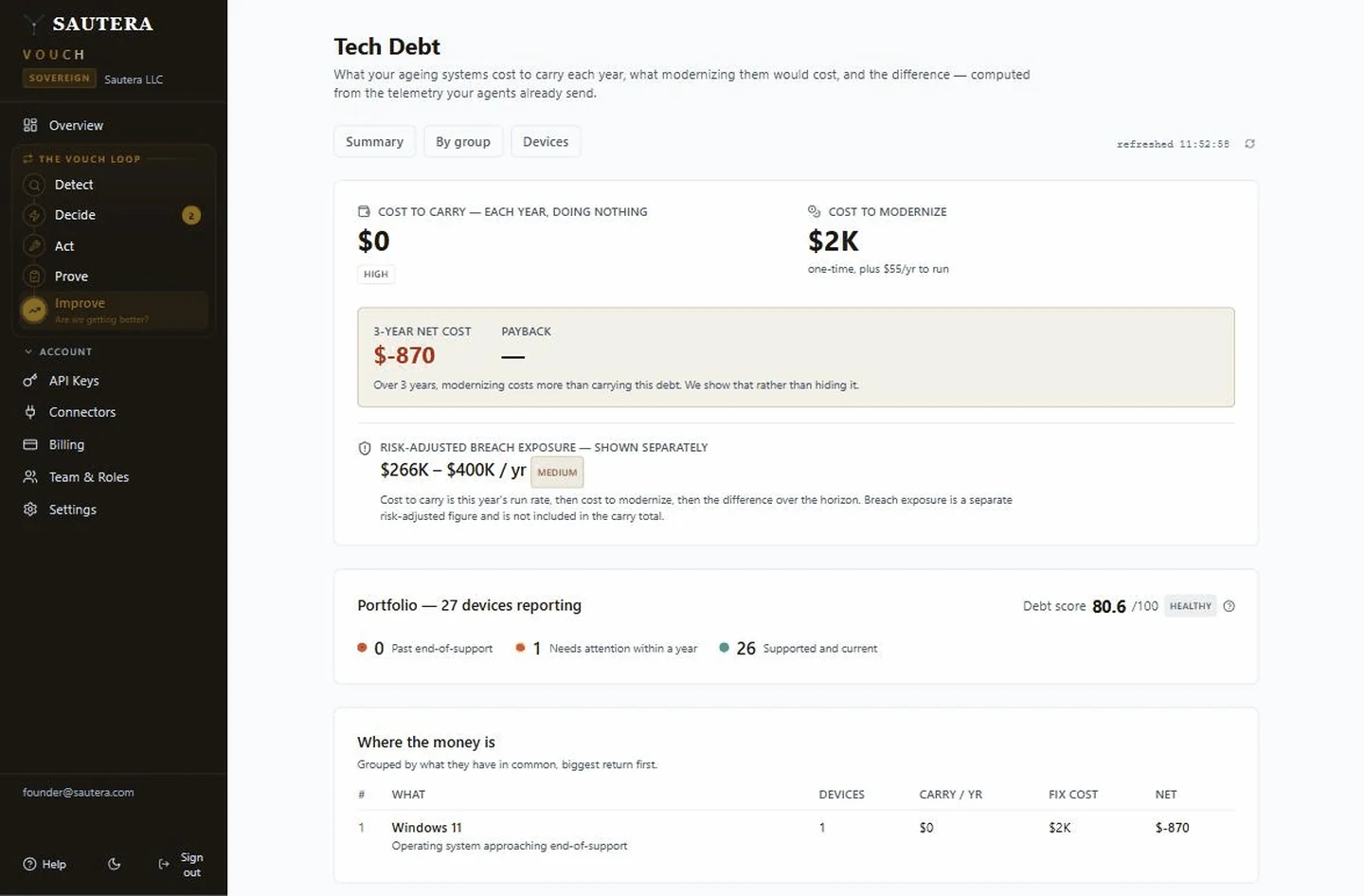
LEDGER, on live production data
Unretouched. The stoplight rolls up findings the trust engine already produces — LEDGER adds the lifecycle reference and the cost model, and no new scoring math.
Where it comes from
Exposure names it. LEDGER prices it.
The lifecycle facts underneath this are the same ones that decide a device’s trust verdict: past end-of-life software can never score Trusted, no matter how healthy the box looks today. If you want the exposure side first — which systems are unsupported, and how far past — start with the free end-of-life scan. LEDGER is what turns that list into a number a CFO can act on.
Every EOL date carries its provenance, because a spreadsheet that cannot cite where a date came from is a spreadsheet with better formatting. A date you supply for your own line-of-business application takes precedence over ours — you know your estate better than a public lifecycle table does.
Straight talk — what this is and is not
LEDGER is a Pro-tier capability, and the numbers are only as good as the assumptions behind them — which is why every assumption is a setting you can inspect and change rather than a constant we buried. It proposes; people decide. Every fix it recommends routes through the same approval a human signs off on, and it never spends, retires or changes anything on its own.
Find out what the old kit is actually costing you.
Start with ten devices free, then price the estate.