Containing a Compromised Identity in Entra: A Live Test
A verified user on a compromised machine, contained in Microsoft Entra with a person approving every step. A staged live test, with the real times.
We staged a compromise on a test machine in our own Microsoft Entra tenant, then watched what happened to the person who used it. Entra itself blocked their next sign-in. A person approved every step, and every step came back undone.
The compromise was staged. We built the machine for the test and opened the weakness ourselves, and we say so wherever this test is described. Everything after that is what actually happened, with the times it happened.
The gap: Entra trusted the person, and the machine was compromised
Identity providers are very good at one question: is this the right person? Entra verified our test user correctly the whole way through. The password was right, the account was in good standing, and nothing about the person had changed.
The machine had changed. We opened an exposed remote-access service on it, the kind of weakness that turns a laptop into a way in. The person was still trustworthy. The machine they were working on was not.
That is the gap we have written about before: zero trust tells you who, not whether. A verified identity on a compromised machine is still a breach path, because everything that person signs in to next inherits the machine's risk.
The test asked one question, and it is the core of infrastructure trust. When the machine can no longer be trusted, can SAUTERA keep the person from carrying that risk into everything else they sign in to, with a human in charge of every action and a clean way back?
What happened, minute by minute
All times are UTC, on 22 November 2026.
| Time | What happened |
|---|---|
| 06:21 | SAUTERA marks the host Untrusted. |
| 06:28 | The user's next access is decided DENY. Entra still trusts the person; SAUTERA no longer trusts the machine, and the most restrictive verdict wins. |
| 06:41 | An operator asks for a containment plan. SAUTERA recommends two actions, isolate the host and contain the identity, and offers a trusted alternative machine for the user to keep working on. |
| 06:57 – 06:58 | An approver approves each action separately. |
| 07:29 | After a deliberate cooling-off, the host is isolated and the identity is contained in Entra. |
| 07:34 | The test user tries to sign in. Microsoft Entra blocks it with error 53003. |
| 07:42 – 07:59 | Release is approved, again as two separate actions. The host is restored, the identity is released, and the user signs in normally. |
Most of that hour is people and the cooling-off, by design. The times are this run's times, not a promised response time.
Why the block is Entra's, not ours
The proof that matters here is not a SAUTERA dashboard saying "contained". It is Microsoft Entra refusing the sign-in.
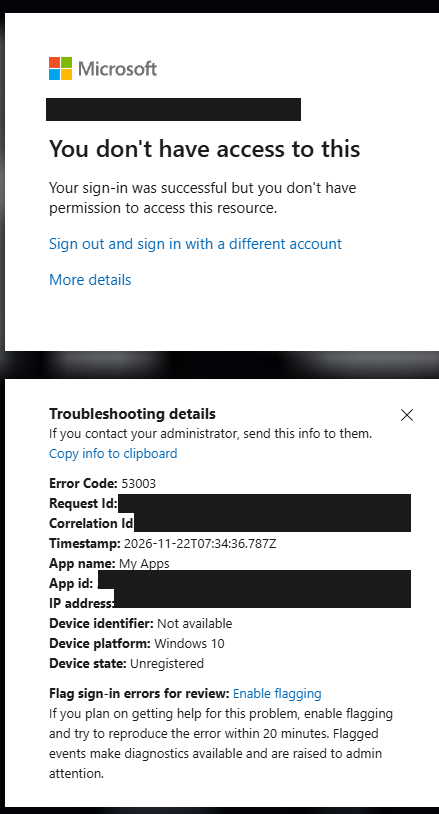
Account name, request ID, correlation ID, application ID and IP address redacted.
Error 53003 is Entra's own code for a sign-in stopped by Conditional Access. Microsoft's Conditional Access troubleshooting guide lists it as BlockedByConditionalAccess. The policy that produced it belongs to the tenant: the tenant created it, named it and switched it on. SAUTERA does not edit Conditional Access.
So the division of labour is clean. Your identity provider stays the authority on the person. SAUTERA is the authority on the machine. At the moment of access those two verdicts resolve into a single decision, allow, degrade or deny, and the most restrictive one wins. When identity containment is approved, the identity provider does the enforcing, under rules the tenant already owns.
A person approved every step
Containing someone's identity is a serious act. It stops them working. It should never happen because a score crossed a line at three in the morning with nobody watching.
In this run:
-
Each action needed its own approval. Isolating the host and containing the identity were separate decisions. Approving one did not approve the other.
-
A cooling-off came before a single approver's decision ran, so the owner could still put it on hold.
-
Protected accounts can never be contained. Break-glass and administrator identities are listed up front, and SAUTERA refuses to act on them. Microsoft's guidance on emergency access accounts makes the same point: keep them out of policies that block sign-in. A tenant that can lock out its own administrators has a second incident waiting.
-
One approval, one action. A case that has run takes no further decisions. Changing it again means opening a new case.
-
Every recommendation, approval, action and release is written to an append-only record, so an auditor can see who recommended, who approved, what ran and what came back.
Closed-loop remediation, human-approved: the system does the recommending and the recording, and a person makes the decision.
The way back matters as much as the block
A containment you cannot cleanly undo is a containment nobody will approve. We have argued that reversibility is the feature to demand from any system that acts on your infrastructure. This run tested it.
At 07:42 the release was requested, as two actions, each approved on its own. By 07:59 the identity was released and the host restored. The test user signed in normally again. The release went through the same approvals and the same record as the containment, because undoing an action is an action too.
What this test did not show
Being precise about the limits is part of the proof.
-
One host and one user, in our own tenant. It shows the full loop works in production. It is not a measurement at fleet scale.
-
The compromise was staged. We opened the weakness ourselves, on a machine built for the test.
-
An isolated host cannot report. Isolation cuts the machine off completely, including from SAUTERA, so it is silent until it is released. That is the point of isolation, and it is also a cost.
-
The times include people. The hour from Untrusted to released includes approvers and a deliberate wait. It is not a response-time promise.
Questions to ask of any containment tool
Whether or not you ever use SAUTERA, these are the questions this test taught us to ask of anything that can lock a person out.
Who enforces the block? If the tool blocks sign-ins itself, you now have two places that decide access, and they will eventually disagree. The better answer is that your identity provider enforces, under a policy you own.
Can a single score contain someone? It should not. Look for a recommendation that a person approves, with each action approved separately, and a wait before a single approver's decision runs.
Which accounts can it never touch? Break-glass and administrator identities need to be excluded up front, and the tool should refuse them rather than warn.
How do you get back? Ask to see a release, not just a block. Undoing a containment should take the same approval and leave the same record.
What does the auditor see? Every recommendation, approval, action and result should land in a record nobody can quietly edit.
The short version
A verified identity on a compromised machine is still a risk, because the person carries the machine's risk into everything they sign in to. In this test SAUTERA caught the machine, recommended containment, and a person approved each step. Microsoft Entra blocked the sign-in under the tenant's own policy, and the release came back the same way. The identity provider stays the authority on the person, SAUTERA stays the authority on the machine, and a human decides.
Try it in your own tenant
A pilot starts in dry-run. The full recommend, approve and record chain runs against your tenant, and nothing changes in Entra. When you are satisfied, containment is enabled for one test user you choose. Your Conditional Access policy stays yours, and so does the decision to turn it on.
If you want to see it with your own identity provider, write to founder@sautera.com.

Written by
Joe Augustine
Author of the Infrastructure Trust Architecture (ITA) and the Infrastructure Trust Conveyance Mechanism (ITCM) — the standard organizations use to decide whether infrastructure can be trusted.
Follow the work
Read the next one
New perspectives on infrastructure trust and updates to the ITA / ITCM framework, by email.
Occasional. No spam. Unsubscribe anytime.